I lost my job in late 2019 and decided to give handmade gifts to my family for Christmas and other gift-giving occasions.
I mean, I had a LOT of time, not a lot of money. And to be quite honest. I have spare fabric.
A LOT of spare fabric.
Mom's Gift Shirt
I have this ... it's not a habit, per se... quirk? Procedure? I dunno. I'll explain it and hope it makes sense.
When I am making something for the first time, and I'm going to make it for someone else, I usually make myself one first. Then, all my lessons learned, I apply to the thing I'm going to make for someone else. When I make bellydance costumes, I usually make mine first, then my troupe-mates. They get things that fit, and I have ... 1st editions with flaws.
So, when making my mother a shirt, I wanted to make her this stretch lace shirt. But I wasn't going to leave it see-through, so I wanted to make it lined with a flesh-tone fabric. So, I created one for me first. Noting where I needed to do things differently and testing techniques.
This is also a Jalie pattern. I'd never made it before. And while I usually recommend making the pattern as written first, then modify it for the second one. I really didn't have time or desire to make the pattern as-is. So, I tested my under-layer technique on a shirt in my size.
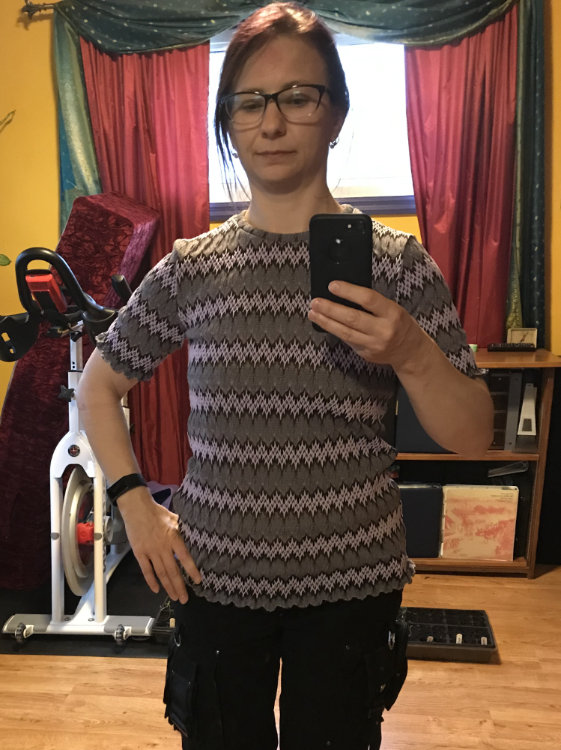
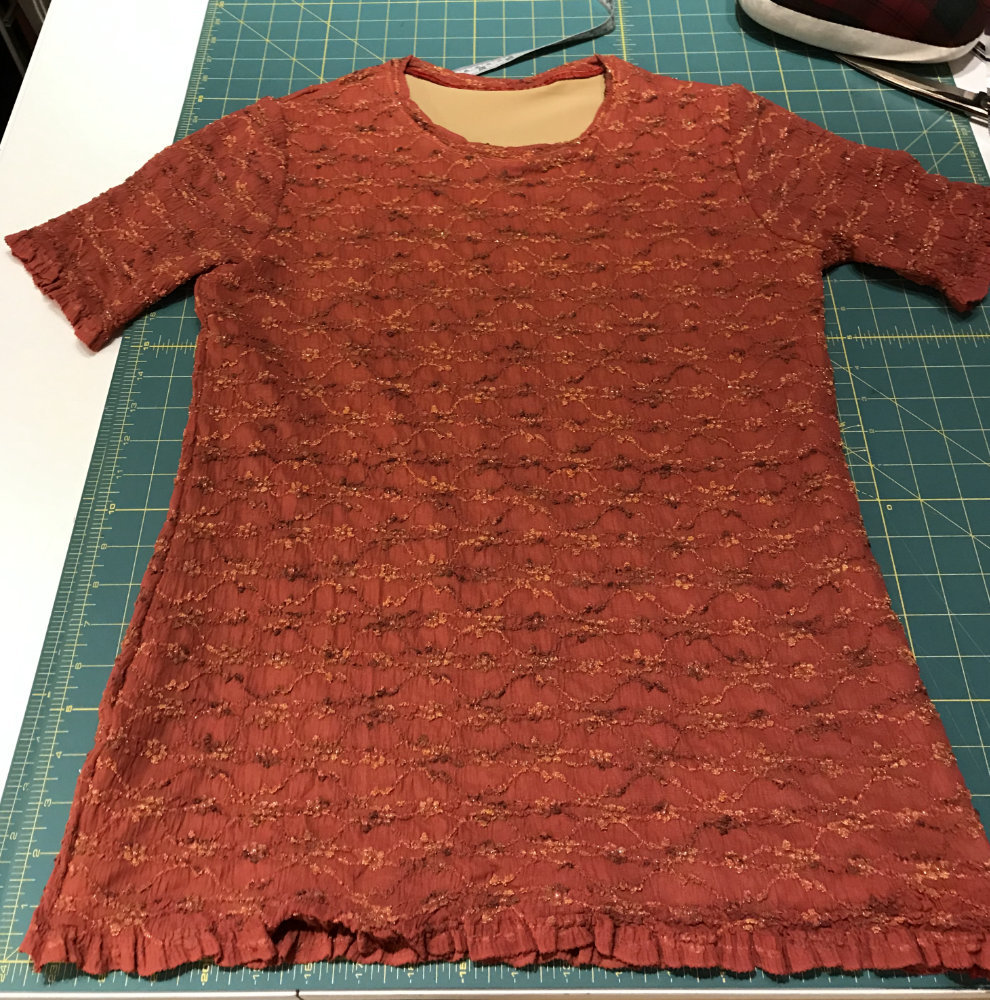
I wanted to use the edge of the lace as a natural hem. But the underlayer fabric (flesh-tone spandex) needed to be hemmed. So, I needed to essentially construct two bodices and 4 sleeves. And then I could stick the underlayer sleeve to the lace sleeve and the underlayer bodice to the lace bodice. Then sew the sleeves into the bodice. That way, the sleeves, and the bodice have the lace overlay separate from the lining fabric at the hem. But the sleeve cap seams wouldn't shift around much.
I also learned that it is not needed to line the collar band. That just makes it way too bulky.
I have mixed feelings about this pattern.
It's super easy to sew. That's a plus. And if you are going to do form-fitted short sleeve shirts, it's fine.
It also is a really good length. It's long enough to easily cover the waist of your pants. But you could also tuck it in it's not too long.
What I'm not sure about, is the sleeves. See, this is a set-in sleeve style. And the sleeve pattern is symmetrical. Which, when cutting, can make things easy. But in reality, the backside of our armhole should be longer than the front. Our back-bodies in this area are just naturally longer than the front. And that's even if you don't have rounded shoulders or forward-head posture that so many of us get from using our computers and phones these days.
If the armhole isn't drafted quite right, the sleeve will not hang quite right on the body. Essentially, the sleeve will twist to make up the difference between what the length of the back armhole should be and what it is.
Now, for super short sleeves in a fitted knit shirt, this might not be a big deal. The repercussions of a symmetrical cap sleeve won't be as pronounced in a short sleeve knit shirt as they would in a woven or a long sleeve shirt.
But, that got me thinking. In this same year, I made a few shirts for my boyfriend. And instead of using a commercial pattern, I decided to draft it myself.
Also, just as a note, I don't totally fault Jalie for drafting their fitted tops this way. There just isn't a standard method for drafting a knit pattern, and so the most prolific instructions show to use the back piece of a standard sloper and make some adjustments then duplicate it for the front and make design modifications like the neck hole. And in doing so, you end up with symmetrical sleeves.